

neurodiversity
neuro-inclusion
inclusive culture
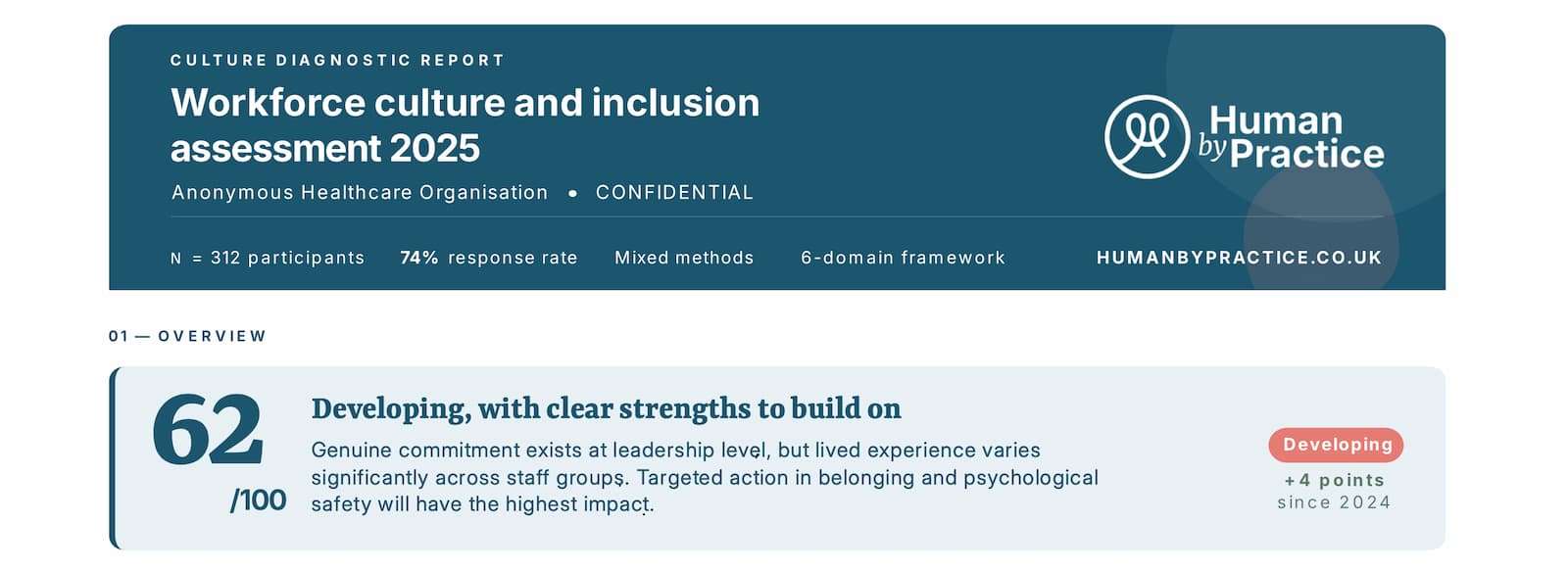

Most organisations know (at some level) that something is off. Maybe the engagement survey numbers look fine but the informal conversations tell a different story. Maybe there is a high-performing team and a team that has lost a bunch of talent over two years and nobody has quite asked why. Maybe you keep running training programmes that feel good in the room and change nothing afterwards.
The problem, in most cases, is not a lack of good intentions. It is a lack of accurate information. Organisations make decisions about culture based on what is most visible, most vocal, and most comfortable to hear, which is almost never the full picture.
That is what the Human by Practice Culture Diagnostic is designed to address.
A culture diagnostic is not an engagement survey. Nor is it is not a policy review or a tick-box exercise that produces a report that sits on a shelf until the next audit.
It is a structured process for identifying what is truly happening in your organisation, the patterns, assumptions, norms, and dynamics that shape daily experience for your people. Including the ones nobody talks about in meetings.
At Human by Practice, our diagnostic is designed to do several things that standard approaches typically miss. It looks at culture as a layered reality: what the senior leadership team experiences is often genuinely different from what a junior employee in a frontline team experiences, and both of those may be different again from what someone with a protected characteristic experiences in what claims to be a 'supportive environment'.
It looks at the gap between stated values and lived reality, which is often one of the most revealing and, frequently, most uncomfortable gaps to surface. Most organisations can articulate their values fairly fluently. Far fewer can demonstrate that those values are consistently experienced on the ground.
The diagnostic is built around three core phases: listen, analyse, and act.
In the listening phase, we gather qualitative and quantitative data through a combination of approaches: a structured survey, one-to-one and small group conversations, and where relevant, documentary review of existing policies, processes, and data. The approach is tailored to your organisation's size, sector, and specific areas of concern.
We pay attention to whose voice is typically centred in organisational decision-making and whose is not. We consider who responds to surveys and who doesn't, and what that absence might be telling you. Who feels safe enough to speak honestly, and who has learned, through experience, that honesty does not pay off.
The analysis phase goes beyond describing what we found. We look for patterns, connections, and root causes. A high turnover rate in one team might initially look like a management problem; but, on closer inspection, it might reflect something more structural about how certain identities are supported (or might not be) in your organisation. A culture diagnostic makes those connections visible.
The action phase is where we invest significant effort. The output of our diagnostic process is a set of prioritised, evidence-based, realistic recommendations; a conversation about what your organisation is ready and able to do; and, for those who want it, ongoing support to implement what comes next.
There are a few things that set the Human by Practice diagnostic apart from more conventional approaches.
First: we do not impose a model. We are not arriving with a predetermined framework that we map your organisation onto. We are genuinely curious about your specific context your history, your sector, and your relationships with the communities you serve or employ.
Second: we centre psychological safety throughout the process. This means designing data collection in ways that allow people to be honest without feeling exposed. Anonymous and confidential is not the same thing, and we are careful about the difference.
Third: we work with complexity. Culture is not simple, and a diagnostic that produces a simple answer ('your score is 6 out of 10') is not telling you much. We work with the messy, contradictory, human reality of how organisations actually function.
The organisations that create genuinely inclusive cultures are the ones willing to find out what is really happening for their people and to act on what they find.
The diagnostic is well-suited to organisations that are ready to hear an honest answer, which requires a degree of courage from senior leadership.
It works particularly well where there is a genuine commitment to change, not just compliance; where there is awareness that something is not working but uncertainty about what; or where a significant event (a discrimination complaint, a leadership transition, a merger, a public reckoning) has made the question of culture suddenly urgent.
If you would like to explore what a culture diagnostic could look like for your organisation, get in touch.
See an example report here: Download the report.
