
neurodiversity
neuro-inclusion
inclusive culture


If you've been tasked with organising neurodiversity training for your managers, you're probably wondering: what does a good session actually involve? What will your managers walk away knowing, and more importantly, what will they be able to do differently?
This guide covers exactly that. Whether you're an HR professional, a People lead, or a manager looking to upskill yourself, here's an honest and practical look at what neurodiversity training for managers looks like when it's done well, and what to watch out for when it isn't.
Around 1 in 7 people in the UK is neurodivergent, meaning they have a brain that works differently to what's considered neurotypical. This includes conditions such as ADHD, autism, dyslexia, dyspraxia, dyscalculia, and Tourette syndrome, among others.
Managers sit at the frontline of inclusion. They're the people making day-to-day decisions about how work is assigned, how performance is assessed, how feedback is given, and how adjustments are made. That makes them the most important lever an organisation has when it comes to creating a genuinely neuro-inclusive workplace.
Without the right knowledge and skills, even well-meaning managers can inadvertently create environments where neurodivergent employees feel unsupported, misunderstood, or penalised for the way their brains work. With the right training, managers become confident, practical allies, and that changes everything.
Good neurodiversity training for managers goes well beyond a list of definitions. Here's what a well-designed programme typically covers:
Understanding Neurodiversity (Without the Jargon): Managers need a clear, accessible foundation. This means understanding what neurodiversity actually is (hint: it's not just ADHD and autism), how common it is in the workplace, and why the neurotypical model of work doesn't work for everyone. Crucially, it should challenge common myths, like ideas that neurodivergent people are less capable, or that visible struggle means poor performance. Good training reframes neurodivergence as difference, not deficit.
How Different Neurotypes Show Up at Work: This is where training gets practical. Managers explore how conditions like ADHD, autism, dyslexia, and dyspraxia might actually show up in their teams, in meetings, in written communication, in time management, in feedback conversations, and in performance. Importantly, good training focuses on strengths as well as challenges. Neurodivergent employees often bring exceptional pattern recognition, creative thinking, attention to detail, or the ability to hyperfocus, capabilities that teams and organisations genuinely benefit from.
Reasonable Adjustments and the Equality Act 2010: Managers need to understand their legal responsibilities without being overwhelmed by legal language. Good training covers the duty to make reasonable adjustments under the Equality Act 2010, what counts as a reasonable adjustment, how to have conversations about adjustments, and how to document and review them. Practical examples are essential here, things like flexible working, written meeting agendas, adjusted deadlines, or changes to the physical environment.
Having Confident Conversations: One of the biggest barriers managers face is not knowing what to say, or worrying they'll say the wrong thing. Good training gives managers the language, frameworks, and confidence to open up supportive conversations with their team members about neurodivergence. This includes how to respond if someone discloses a diagnosis, how to check in without prying, and how to separate performance management from a lack of reasonable support.
Practical Strategies for Everyday Management: The best neurodiversity training doesn't just raise awareness, it builds skills. Managers should leave with actionable strategies they can use immediately, such as:
Format matters. Neurodiversity training that's delivered as a death-by-PowerPoint lecture is unlikely to change anything. The best sessions are interactive, grounded in real workplace scenarios, and designed so that managers actually practise the skills they're learning.
A typical half-day session for managers might include:
Full-day programmes go deeper, allowing more time to practise conversations, explore complex scenarios, and build a shared language across the management team.
For many organisations, the most effective approach is a blended one — a core training session followed by manager coaching, peer learning, or drop-in clinics where managers can get support on specific situations they're navigating.
Not all neurodiversity training is created equal. Here's how to tell the difference between training that will genuinely shift thinking and behaviour, and training that just ticks a box:
Good training draws on both research and real experience, not just clinical definitions. Where trainers have lived experience of neurodivergence themselves, or work closely with neurodivergent communities, the training tends to be richer, more nuanced, and more credible to the people in the room.
Training that frames neurodivergence purely as a list of problems to manage does more harm than good. The best training takes a strengths-based approach, helping managers see the full picture of what neurodivergent employees bring, not just what they might find difficult.
Generic training rarely lands as well as something designed with your context in mind. The best programmes are adapted to your industry, your team size, and the specific challenges your managers face, rather than being a one-size-fits-all package delivered to every client.
Awareness is a starting point, not the destination. The goal of neurodiversity training for managers should be to change behaviour, how managers communicate, how they make decisions, and how they create conditions where everyone can do their best work.
Neurodiversity training is most impactful when it reaches:
For maximum impact, training works best when it's part of a wider culture shift, not a standalone session delivered once and forgotten.
When evaluating neurodiversity training providers, here are the questions worth asking:
At Human by Practice, our Neurodiversity and Accessibility in Practice programme is designed specifically to give managers the knowledge, confidence, and practical tools to build genuinely neuro-inclusive teams.
The training is grounded in evidence and lived experience, tailored to your organisation's context, and focused firmly on behaviour change, not just awareness-raising. We work with organisations across the UK, from SMEs to large public sector bodies, helping them build workplaces where neurodivergent people can genuinely thrive.
If you'd like to find out what neurodiversity training could look like for your team, book a free discovery call or get in touch.
Book a discovery call: humanbypractice.co.uk/meetings/jessica-sandham
Explore the programme: humanbypractice.co.uk/neurodiversity-neuro-inclusion-training
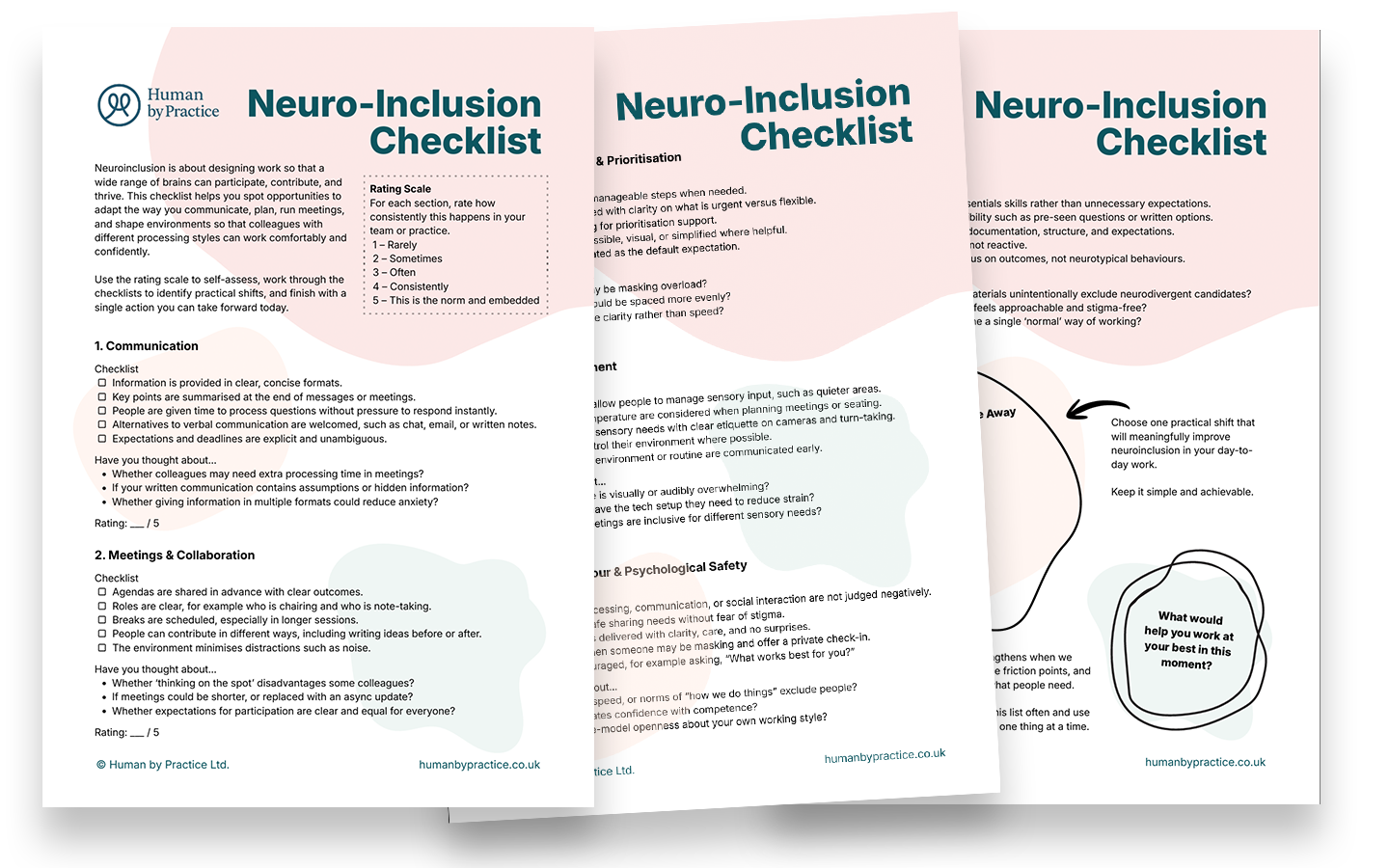
Check out our free, downloadable neuro-inclusion checklist: